The Derby della Capitale is not a football match you attend. It's one you survive, argue about for years, and never entirely recover from.
Roma vs Lazio splits the city not just by colour — giallorosso vs biancoceleste — but by neighbourhood, by class, historically even by politics. It is the kind of fixture that turns quiet lunch tables into shouting matches between people who sat in silence for an hour beforehand. Every Roman has a side. Many would rather not speak to you on derby day until they've established which one you're on.
Foreign fans arriving at Fiumicino or Termini with a ticket in hand and a loosely planned afternoon ahead are missing most of what makes this day extraordinary. Here's what actually goes on — and where.
What the Derby della Capitale Actually Is
Serie A has derbies. The Derby della Capitale is different.
While Milan has its own version and Turin its, Rome's derby carries the weight of a genuinely divided city. Roma fans skew historically working-class, from the southern and eastern boroughs — Testaccio, Trastevere, Tor Pignattara. Lazio's support has its roots in the north, in the military and professional classes, though the reality today is more complicated than any shorthand.
What matters for a visitor is this: in Rome on derby day, almost nobody is neutral. The streets, the bars, the traffic — everything feels different. Knowing that is step one.
The Morning: Don't Waste It in the Hotel
The temptation is to sleep late, eat at the hotel, and head to the stadium mid-afternoon. This is what tourists do.
Romans who care about football — which is almost all of them — are already in motion hours before kickoff.
Testaccio is where to start, particularly if you're in Rome without prior tribal allegiance. The neighbourhood sits on the Tiber's east bank, just south of the Aventine Hill. It was Rome's working-class heart for most of the twentieth century and it remains the birthplace of Roma's first genuine fan culture. The club played its first matches at the Campo Testaccio, a ground that no longer exists but whose ghost is still present if you know where to look.
The Testaccio market is worth an hour of anyone's morning — not for the produce stalls, but for the food counters in the interior. Offal sandwiches. Supplì. Coffee standing at the bar while two men argue about the starting lineup. This is the ordinary weekday texture of Rome, heightened.
For Lazio fans, Prati — the neighbourhood immediately north of the Vatican — offers a different mood. Historically bourgeois, orderly, with a different volume of derby tension.
Early Afternoon: The Pre-Match Rituals That Actually Matter
By the early afternoon, the city is operating on two parallel tracks: those invested in the match, and everyone else who has quietly decided this is a good day to stay home.
The bars near Ponte Milvio in the north of the city have long been associated with Lazio's support, particularly the young and ultras-adjacent crowd. These are not tourist bars. You will hear things you don't understand. The atmosphere is compressed and specific. Go if you want the real version — but go aware.
Closer to the Olimpico, the Flaminio neighbourhood begins to fill in the hours before kickoff. The geometry is interesting: Roma and Lazio share the same stadium, which means rival fans are navigating the same streets, the same metro carriages, the same queues for coffee. The choreography of how Romans manage this — mostly through an elaborate, slightly comic territorial arrangement — is itself worth watching.
What to eat before a Derby della Capitale:
- Carciofi alla romana o alla giudia — artichokes, either braised or fried, depending on which Roman you ask and how much time you have for an argument
- Coda alla vaccinara — oxtail stew, unmistakably Roman, found at almost any serious trattoria in Testaccio and Trastevere
- Supplì al telefono — fried rice balls with mozzarella; the mozzarella stretches when you pull them apart, hence the name. Do not leave Rome without one.
None of these require a restaurant with a tourist menu or an English-language sign outside.
The Stadio Olimpico: What You Need to Know
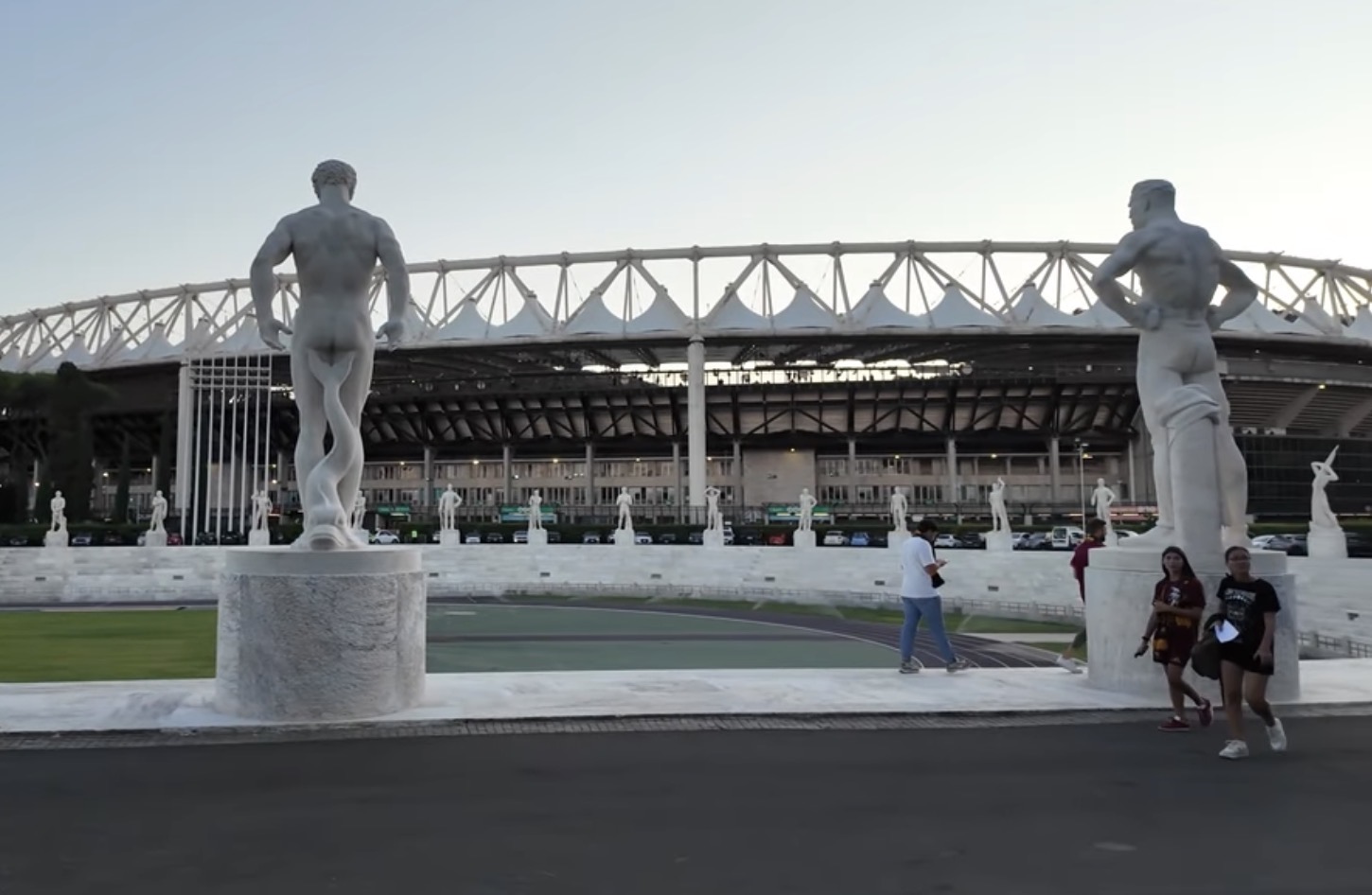
The Olimpico sits in the Foro Italico complex at the northern edge of the city — originally constructed for Mussolini's aborted 1940 Olympics bid, repurposed, rebuilt, and now a monument to decades of calcio history.
A few operational notes that save confusion:
Roma fans sit in the Curva Sud (south end) and the associated Distinti Sud. Lazio fans hold the Curva Nord. If you have a ticket as a neutral visitor, you will almost certainly be in the Tribuna Tevere (east side) or Tribuna Monte Mario (west). These are the sanest sections for foreign fans — not because the football is less visible, but because the geopolitics are simpler.
Getting there: Metro A to Ottaviano, then tram or bus north toward Foro Italico, or a longer walk through Prati. The metro runs overcrowded on derby day. Leave significantly more time than you think you need.
What to bring: Your ID (required for entry), the ticket itself (usually mobile), and more cash than you expect to need. Concession options inside Italian stadia remain limited by most international standards.
What Foreign Fans Almost Always Miss
This is the part no travel guide will tell you, because most travel guides are written from the outside looking in.
The matchday experience of a Derby della Capitale is as much about the sound of the city as anything visual. The drums that start in the Curva Sud car park two hours before kickoff. The call-and-response that moves through the crowd in waves during the warmup. The way the stadium falls briefly, specifically silent in the ninety seconds before the referee blows the opening whistle — and then erupts.
None of this is accidental. It's choreographed, rehearsed, culturally transmitted from one generation of supporters to the next. Foreign fans who spend those two hours in a hotel room, or eating at a chain restaurant near Termini, arrive at the stadium for a football match. The ones who understand what the morning and afternoon are actually for arrive for something else.
The difference is not about insider knowledge. It's about deciding that the city itself is part of what you came to see.
A Note on Safety and Common Sense
The Derby della Capitale has a complicated history. Serious incidents are now rare, and the 2020s version of this fixture is considerably better managed than the version from thirty years ago. Foreign fans attending as genuine neutrals, without provocation and without the wrong scarf in the wrong section, are overwhelmingly fine.
Common sense applies: don't wear a rival club's shirt into the wrong end. Don't photograph ultras close-up without implicit permission. Navigate confidently. The city is not hostile — it's just operating at a frequency that rewards a bit of preparation.
Make the Most of It
If you want to do this properly — with the kind of local knowledge that only comes from genuine immersion, in a group small enough to actually go places a tour bus cannot — FanHoppers runs curated matchday experiences for foreign fans in Rome on Derby della Capitale matchdays.
Small groups. An Ambassador who lives the fixture, not narrates it. The neighbourhoods above. The food above. The version of the city most fans never find in time.
Get Launch Updates